Currently studying CS and some other stuff. Best known for previously being top 50 (OCE) in LoL, expert RoN modder, and creator of RoN:EE's community patch (CBP).
This concept is applicable near universally: games, economics, computer parts, whatever. If the category exists, the things within it are almost certain to be roughly balanced.
For “quick and dirty” comparisons between two things, this concept is incredibly valuable to understand. When you just need to know roughly whether something’s worthwhile, you can save a lot of time by keeping the deep analysis for later.
This question was originally posted on the RoN subreddit, and this article has been adapted from my reply.
There’s two things that this question could be tackling, either rushing, or general unit production. For the purpose of my answer I’m assuming the latter.
In that case, there’s 3 bottlenecks:
The speed at which each individual unit is produced.
The number of units being produced at the same time (i.e. 2x barracks will pump out infantry at 2x speed).
If you have the resources to continue building with no downtime.
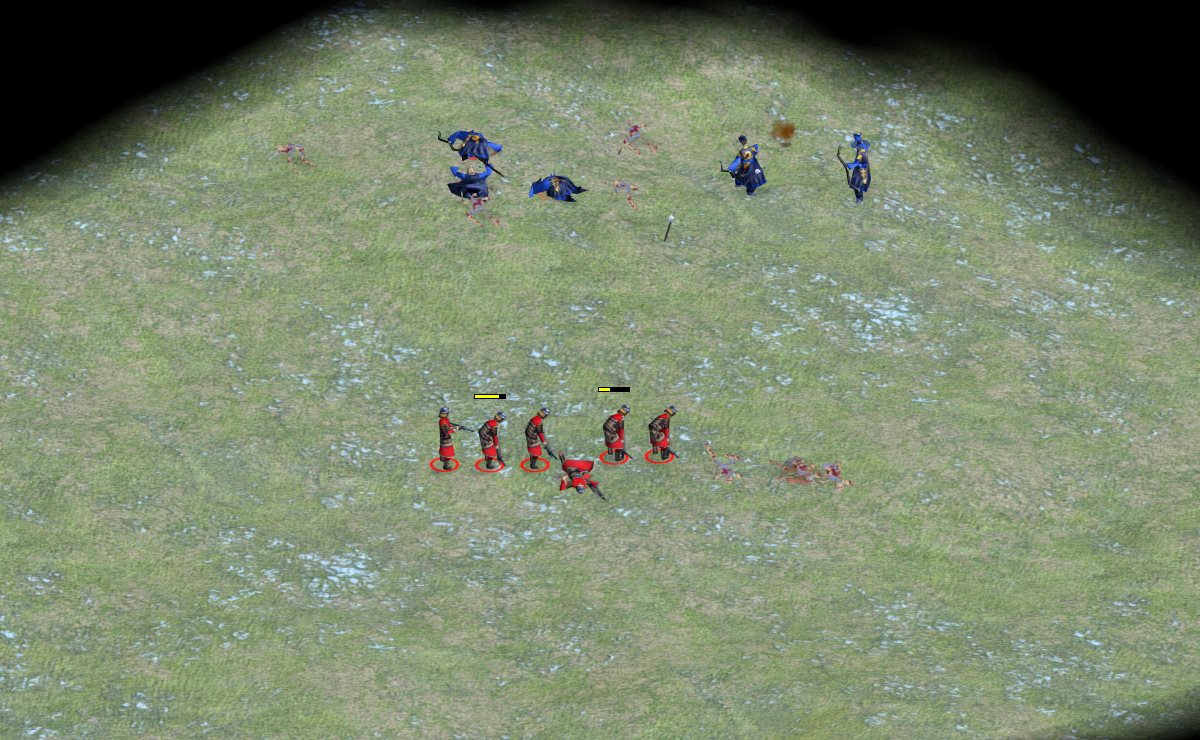
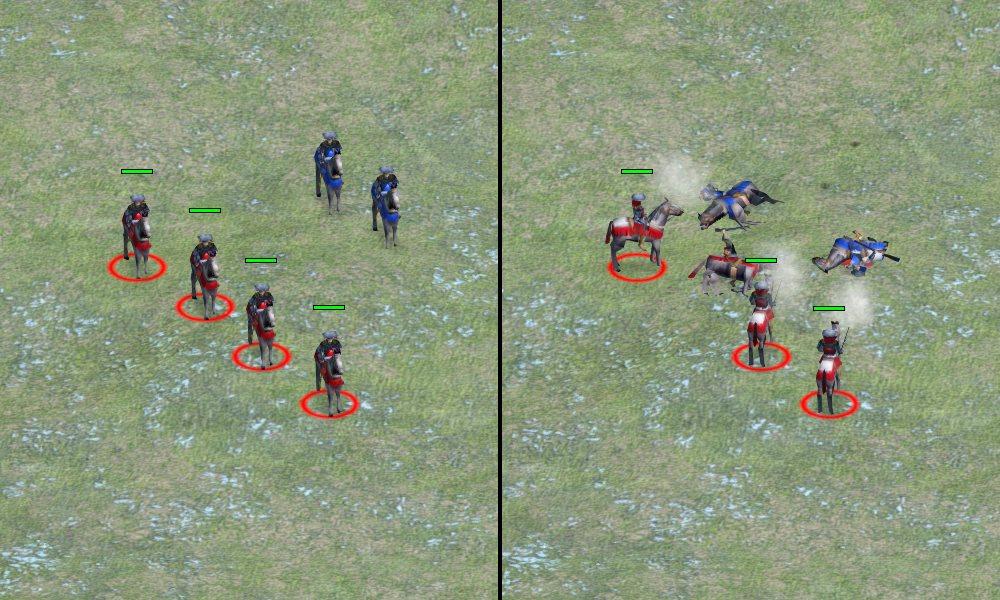
4 Dragoons will beat 2 Dragoons twice and then some.
An army that is twice as powerful as its opposition — whether due to size, unit upgrades, General/Patriot buffs or something else — can deal with a half-strength army more than twice. An army that is ten times as powerful (think Machine Guns vs Crossbows or something) can face the tenth-strength army a near-infinite amount of times in practical terms.
The application of an army’s power against an opposing force does not scale linearly with the army’s apparent power. Whenever you increase an army’s strength, you increase its fighting capability by more than what you added. Army strength increases non-linearly.
As of writing this article, I have played only three games of Rise of Nations against human opponents other than my friends. Crucially important in this distinction is that my friends are all less experienced players than me: the friend I have played against the most started playing the game just two months ago. I helped him learn basic economic optimisations (don’t rush a temple on your first city there friendo), serviceable army compositions (anti-tank rifles when facing completely infantry: never again), and other core game concepts.
Until two months ago, I had only played against a human opponent in Rise of Nations once or twice.
This year I didn’t reach Challenger – or even get within reach of it at D1/Masters. But I did learn and improve, and can carry what I’ve learnt into the next season. I also soared into Honor 5 despite it often being used as an “MVP award” – and I’m rarely a flashy player.
Diamond 2 in Solo/Duo at the season’s end. Respectable, yet still tinged with a whisper of disappointment.
Note: I highly recommend playing Alien Swarm: Reactive Drop instead of the base game Alien Swarm. It’s a fan-made upgrade that’s better in basically every way – and just like the original, it’s free!
Alien Swarm lets you choose from a roster of 8 characters spread across 4 distinct classes. There are 21 selectable weapons (25 in Reactive Drop) to equip as either a primary or secondary weapon, and 17 additional equipment choices for your third item. All up, that makes a lot of combinations possible, particularly when you have a full squad of 4 people – and RD even lets you go up to a squad size of 8!
For some reason I can’t find an up-to-date command list from a single source online other than the source code itself, so I’ve patched the information together into one place, checked it against said source code, and put it here instead.